


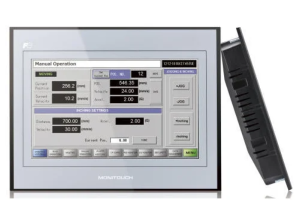
Speed, clarity, and control are actually more important today than they have ever been to help speed along at the pace of today’s industrial and business worlds. Machines get smarter, processes get more complex, but people need a simple way to control everything without confusion. That is where modern touch-based interfaces step in. An HMI Control Panel acts as a bridge between people and machines, turning complex data into clear visuals and easy actions.
Much like Swiss Army knives, which can do just about everything, HMI touch screen displays put many functions into one dynamic interface. They assist the operator in observing systems, controlling processes, and making quick decisions on a single screen.
What Is an HMI Touch Screen Display?
What is HMI?
HMI is short for Human Machine Interface. In other words, it’s a screen that enables a human to interact with a machine. The use of a screen enables the direct interaction of a human with a machine without the need to physically interact with a button or switch, or even send software commands.
Currently, an HMI Control Panel display provides real-time information on variables such as temperature, pressure, speed, alarms, and status. It also helps in controlling processes, such as turning on, off, or regulating machine functionality in a matter of clicks.
Why All-in-One Matters in Industrial Control
Previously, it was necessary to use several devices such as meters, switches, and control units. However, the present All-in-One solution for HMI integrates control and display into one extremely small system.
An all-in-one HMI Control Panel can help in de-cluttering, ease of training, and smooth workflow. It allows operators to carry out their tasks without the need for a single button press, as they can access all information from one intuitive screen.
Major Benefits of HMI Touch Screen Displays
1. Easy Visualization
HMI screens simplify data into charts, graphs, and icon displays. This way, users can understand the system’s performance at a glance. An exceptional HMI Control Panel can make a process look simple, even if the process is very complicated for new users.
2. Speedier Decision
With the data available and controls accessible, the decision is made faster. The real-time alerts and alarms avoid machine failures.
3. Enhanced Accuracy
Tactile-based selections cut down on any errors resulting from manual entries. Operators are able to choose between specific values or options for better precision within the operations.
4. Space and Cost Efficiency
Instead of having several control devices, all can be accommodated with one HMI Control Panel. This saves space, lowers wiring costs, and reduces long-term maintenance expenses.
Industry Applications
The flexibility and reliability of HMI touch screen displays are the reason why they are employed in many sectors.
They also served in manufacturing to monitor production lines, machine health, and quality of output. In power and energy systems, they display voltage levels, load status, and fault alerts. The flow rates, tank levels, and safety alarms are managed in the water treatment plants.
From all of these usages, the HMI Control Panel becomes a centerpiece command center that facilitates operators to operate without much hassle.
Role in Smart and Connected Systems
As industries shift to a more automated environment and Industry 4.0, HMIs are getting smarter by providing features for data logging, remote monitoring, and integration with PLCs, Scada systems, and cloud technologies.
A future-ready HMI Control Panel not only displays information, but it also connects systems, aids in analysis, and enables businesses to make informed decisions through data. This makes it suitable for digitalization initiatives.
Easy Maintenance and Scalability
Another major advantage is that it is scalable. That is, as the operations grow, the HMI system can be easily changed using more screens, etc.
A flexible HMI Control Panel exists, allowing the system to receive updates and additions, thereby helping businesses remain competitive with lesser investment.
FAQs
What is the principal function of the touch screen display of the HMI?
The basic idea is to enable the operators to have an understanding of the state of the machines as well as control their operations in a convenient manner.
Is an HMI suitable for small businesses?
Yes. The systems available today for HMI are scalable and can be used in small systems as well as large industrial plants.
What are some ways in which an HMI enhances safety?
For example, they can receive real-time information about alerts, alarms, system conditions in order to act quickly to a situation and avoid accidents.
Will an HMI work with existing machines?
Most HMIs are intended to be compatible with popular controllers and systems, with upgrade capabilities.
Why is an all-in-one solution better?
All-in-one system simplifies a complex part to save space, lessen the need for maintenance, and also advances the efficiency as all control is centralized.
Final Thoughts
The HMI touch screen display is an indispensable component of modern monitoring and command techniques. It simplifies what is an inherently complicated process, provides greater accuracy, and, most importantly, is the foundation for more intelligent decisions. Therefore, the definition of an integrated HMI Control Panel is one that involves a complexity of functions beyond simply a display, as it is the best means of connecting people to machines.
In a constantly changing world of industries, investing in a dependable and user-friendly HMI system means being ahead of the curve today and tomorrow.